

The River Bottomland Environment: Central Illinois Alluvial Soils
Properties situated along the Sangamon River corridor, South Fork drainage basins, Lake Springfield shorelines, and low-lying alluvial plains in Sangamon County boast lush natural woodlands and scenic water views. However, this riparian environment subjects mature trees to unique hydrological stressors rarely encountered on upland suburban parcels. When seasonal flooding saturates bottomland soils, even massive trees can experience rapid root failure, structural destabilization, and severe leaning trunks. Riparian woodlands along the Sangamon River basin and Lake Springfield experience hydrological forces that demand specialized arborist care.

Saturated Soil Mechanics: Why Floodwaters Weaken Root Friction
The primary mechanical cause of tree failure following river flooding is soil liquefaction and friction loss. Sangamon River bottomlands feature deep layers of alluvial silt, sand, and heavy illite clay. Under normal conditions, soil particles are compacted and provide immense friction against lateral tree roots. However, during prolonged flood events, water fills all soil pore spaces. As hydrostatic pressure increases, soil particles lose cohesion, turning firm ground into a soupy slurry that cannot anchor heavy root balls against gravitational pull. Prolonged flood inundation saturates alluvial silt and clay soils, causing soil liquefaction and loss of friction holding heavy root balls.
Need Professional Advice for Your Trees?
Call our local dispatch desk at (858) 780-5212. We provide prompt on-site evaluations across Springfield and Sangamon County.
Root Hypoxia and Anaerobic Rot: The Invisible Threat Beneath the Surface
Beyond mechanical stability, standing floodwaters induce a severe biological condition known as 'root hypoxia.' Tree roots require oxygen for cellular respiration to absorb water and nutrients. When soil remains submerged under floodwaters for several weeks, oxygen is completely depleted, creating an anaerobic environment. Deprived of oxygen, fine root hairs suffocate and die within days. Anaerobic pathogenic fungi—such as Phytophthora and Pythium—proliferate rapidly, rotting structural roots from the tips inward. Submerged soils suffer rapid oxygen depletion, inducing root hypoxia that rots structural anchoring roots from the tips inward.
Bank Erosion and Soil Undercutting Along Sangamon Tributaries
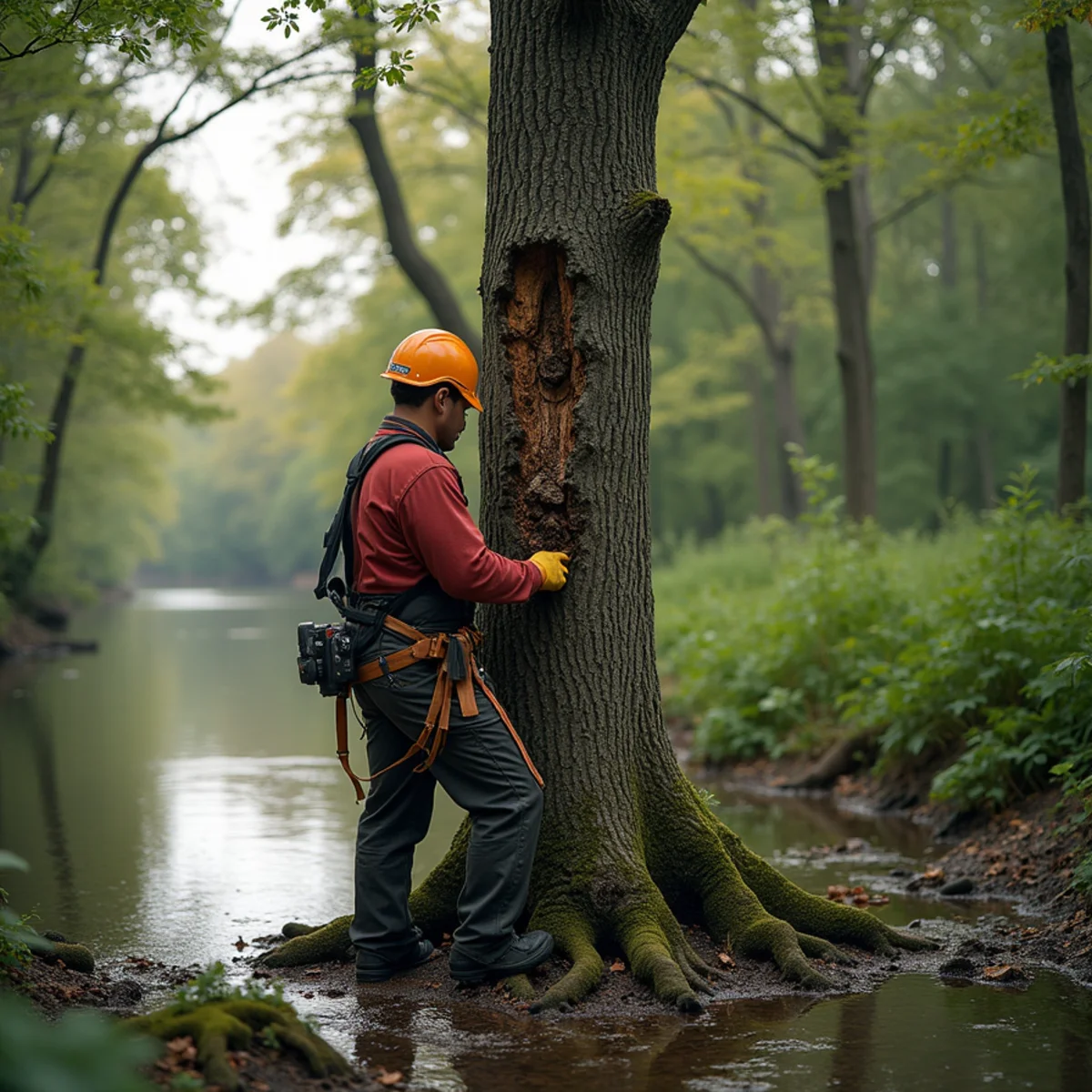
Riverbank erosion and hydraulic undercutting represent another constant hazard for waterfront properties in Riverton, Petersburg, and rural Sangamon County. High-velocity flood currents wash away soil directly beneath the root flares of shoreline timber. When three to five feet of supportive soil is carved away from one side of a tree, the specimen develops an abrupt, dramatic lean toward the waterway or adjacent structures, threatening docks, boathouses, and residential homes. Riverbank current erosion undercuts root flares, causing trees along waterways to develop acute, dangerous leans toward docks and homes.
Identifying Sudden Leans: When a Waterlogged Tree Becomes Critical
Detecting a dangerous post-flood lean requires careful site inspection. While trees that grow naturally on riverbanks develop curved trunks with strong compensatory wood, an acute, sudden lean accompanied by cracked or mounded soil on the uphill side indicates imminent root plate failure. If you notice tension cracks in the turf behind a leaning tree, or if previously buried root flares have popped above ground level, the tree is in an active state of failure. A sudden post-flood lean accompanied by tension cracks in uphill soil indicates active root failure and requires immediate tree removal.
Bottomland Species Vulnerabilities: Willow, Cottonwood and Silver Maple
Native bottomland tree species have evolved varying adaptations to flooding, but each has structural limitations. River birches, sycamores, and bald cypresses tolerate seasonal inundation exceptionally well and feature strong root plates. Conversely, fast-growing bottomland dwellers like black willows, boxelders, silver maples, and eastern cottonwoods are notorious for weak wood and shallow root plates, making them the most common trees to tip over following high-water events. Fast-growing bottomland species like black willows, cottonwoods, and silver maples have shallow root plates that tip over easily after floods.
Specialized Low-Ground-Pressure Machinery for Wet Riverfront Properties
Removing hazardous trees on saturated riverfront parcels demands specialized tree equipment. Standard heavy bucket trucks and wheeled cranes will sink axle-deep into wet alluvial soil, causing severe turf gouging and getting trapped. Professional arborists deploy compact rubber-tracked aerial lifts and self-propelled winching equipment, utilizing heavy composite ground protection mats to navigate delicate riverbank terrain with zero soil damage. Deploying compact tracked equipment and heavy composite turf mats allows arborists to navigate saturated riverfront soils without getting stuck.
Frequently Asked Questions About Flooding and Leaning Riverfront Trees
Prompt post-flood hazard assessments by certified arborists protect riverfront property owners from catastrophic tree failures. At On The Grind, our team possesses extensive experience evaluating riparian timber along the Sangamon River basin, providing objective risk assessments, surgical rigging, and safe hazard mitigation. Certified arborist evaluations help waterfront homeowners identify weakened riparian timber before falling trees damage structures or shoreline access.
Frequently Asked Questions About Flooding and Leaning Riverfront Trees
Dormant winter trees can withstand several weeks of flooding without damage. However, during the summer growing season, standing water exceeding 7 to 14 days causes root suffocation and rapid decay.